
Search for a vending machine website example and you mostly get template marketplaces and Pinterest boards — pictures of websites, made by designers, judged as pictures. What you can’t easily find is a real operator’s site torn down page by page, with the reasoning behind each decision explained.
So here’s one. In August 2026 we built www.azexpressvending.com — 29 pages of local SEO for AZ Express Vending, a family-run vending operator serving Los Angeles, Ventura, and Orange County — and shipped it in under two days. Open it on your phone alongside this walkthrough. Everything below is checkable on the live site.
Short on time? The whole build in one case-study video:
Who is AZ Express Vending — and what did the site have to do?
AZ Express Vending is a family-run operator based in Sunland, in the San Fernando Valley. They place brand-new snack, drink, combo, and hot coffee machines at businesses 100% free — free install, free weekly restocking on their own routes, no contracts, no minimum employee count. Revenue comes from product sales, so the site’s one job is convincing an office or facility manager that “free” is real. They also sell new American-made machines and run free office coffee and healthy vending programs.
That makes this a free vending machine placement website at its core: every page has to answer “do you cover my area, what’s the catch, and how do I start” before the visitor scrolls.
One decision worth copying: AZ Express is a service-area business, so the site deliberately publishes locality only — no street address anywhere. Routes are geographic; the storefront isn’t the point.
What does a good vending machine website look like?
Roundups of the best vending machine websites tend to judge screenshots — colors, hero images, layouts. An operator should judge differently: does the site answer the location decision-maker’s three questions fast, and can machines read it as easily as people?
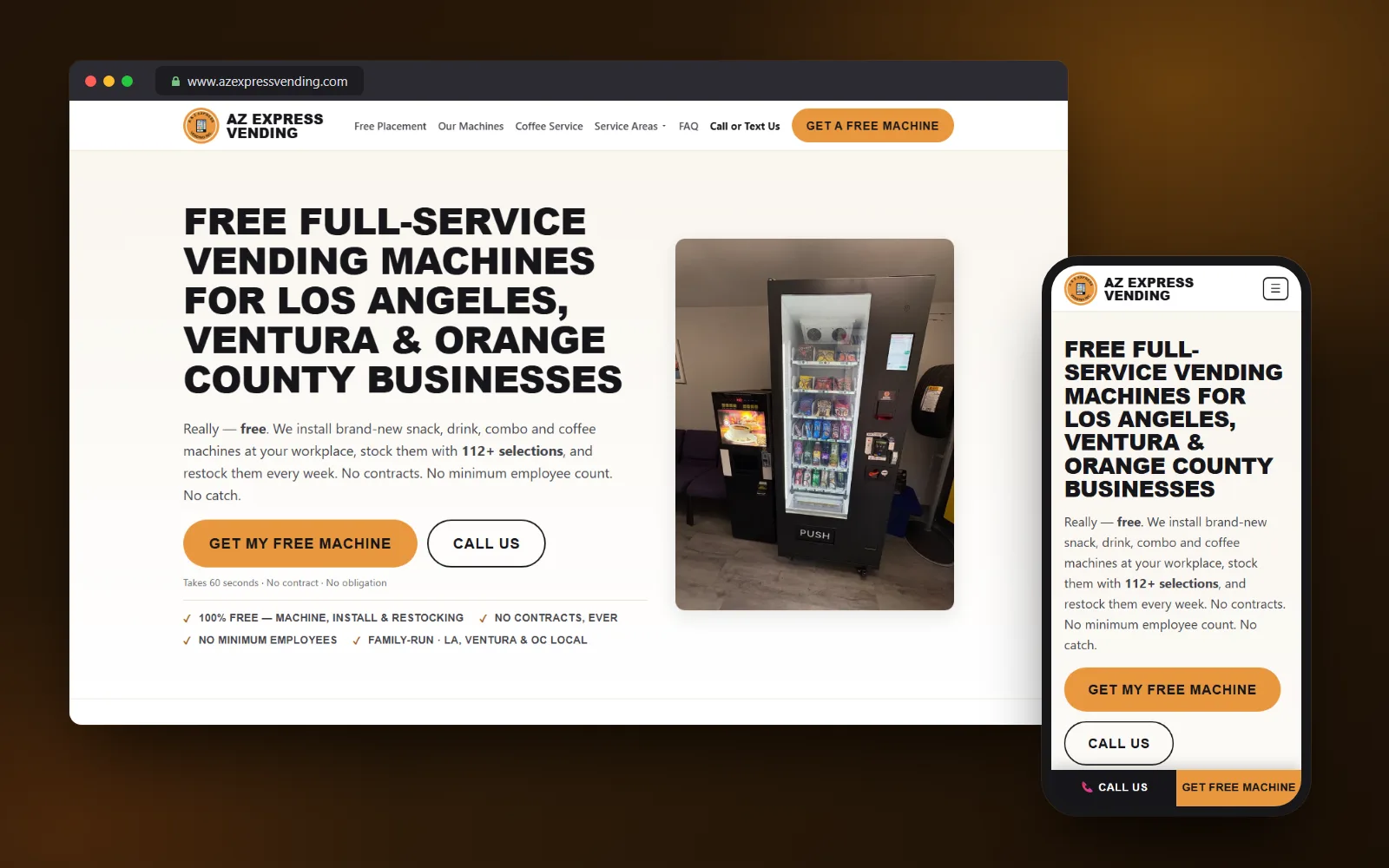
On this build that means a trust bar in the hero — 100% free, no contracts, no minimum employees, family-run and local — a lead form or call link within reach on nearly every page, and 13 real installation photos from actual customer locations instead of stock imagery. Machines with 112+ selections that take cash, cards, and tap-to-pay get said plainly, because those are the questions employees ask their office manager.
The part you can’t see matters just as much: the site is engineered to load instantly and stay rock-steady on a phone. Fast is a feature a facilities manager feels from the first tap — and it’s the thing most vending sites get wrong.
Why does one vending machine company website need 29 pages?
Because Google matches queries to pages, not to businesses. “Office coffee service” and “vending machines Burbank” are different searches, and one homepage can’t rank for both. The AZ Express architecture:
The homepage plus six service pages. Free machine placement (the flagship), a machine-type catalog, office coffee service, healthy vending, breakroom solutions, and a machines-for-sale page with six American manufacturer brand cards. One page per thing they sell, each able to rank and convert on its own.
Six industry pages. Corporate offices, warehouses, manufacturing plants, car dealerships, schools, and outdoor sites. These exist because the buyer’s worry changes by industry — the warehouse page talks 24/7 multi-shift coverage, the school page talks California Smart Snacks compliance. Same machines, different objections.
Three county hubs and eight city pages. Hubs for Los Angeles, Ventura, and Orange County — branded on-site as “the corridor from Somis to Santa Ana” — with eight city pages generated from a single dynamic route. More on these below, because they’re the most copied-wrong part of local SEO.
The rest. A FAQ page carrying all 19 questions with schema, About and Contact, a noindexed thank-you page, and a custom 404. Total: 29 routes.
How do you do vending machine local SEO without doorway pages?
The lazy version of vending machine local SEO is 80 city pages where only the city name changes. Google has discounted that pattern for years, and it’s the fastest way to torch a new domain’s credibility.
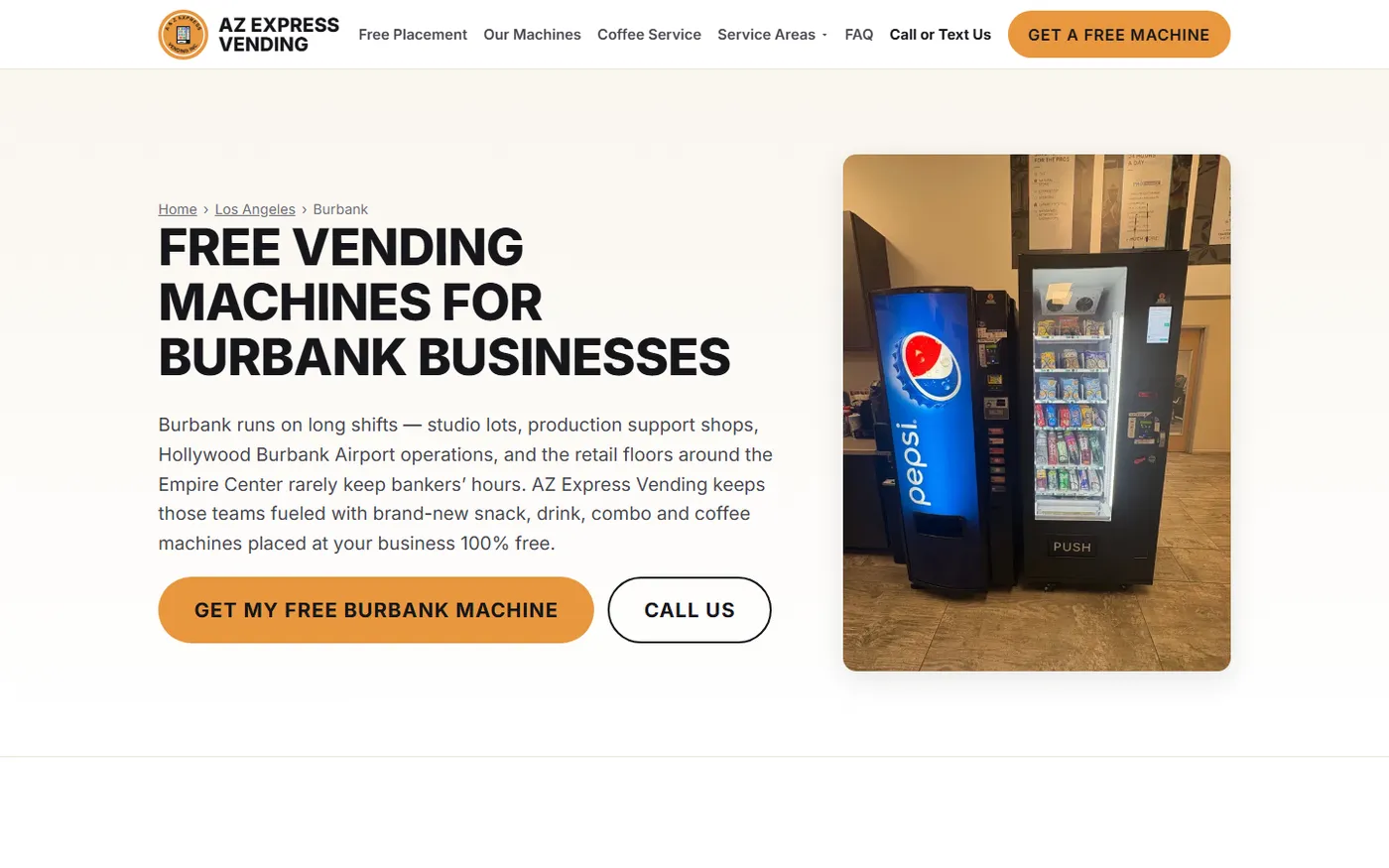
This build launched with just eight city pages, each one written like we’d actually driven the route. The Burbank page talks about the Media District and Hollywood Burbank Airport. Glendale gets Brand Blvd and the Americana. Oxnard gets Port of Hueneme logistics; Camarillo gets the Mission Oaks business park. That specificity is the anti-doorway signal — copy nobody could paste onto another city’s page.
Everything that didn’t earn a city page lives on the county hubs instead, and the site expands outward on demand data rather than wishful thinking. Exactly how we decide which cities earn a page is part of the local SEO craft we sell — the short version is that the site earns its territory instead of claiming all of it on day one.
How does a vending site get recommended by AI assistants?
A growing share of “vending machine service near me” questions now get asked to ChatGPT or answered by Google’s AI results, and those systems only recommend businesses they can read. This build treats that as engineering, not mystery: every one of the 29 pages tells search engines and AI crawlers, in their own machine-readable format, exactly who this business is, what it offers, and where it operates — consistently, so the entity never blurs — and the site is deliberately open and legible to the AI crawlers that matter.
The specifics of how we structure that are the AI search optimization playbook we sell, so this is one section where we describe the outcome and keep the recipe. What we will publish is the scoreboard: the ranking log at the bottom of this page tracks — in public — when Google positions move and when AI engines start citing the site.
How does a static site capture leads with no backend?
There’s no server here, and no monthly platform fee. The lead form — headline: “Get Your Free Vending Machine” — delivers submissions straight to the owner’s inbox, with spam filtered quietly in the background and every lead tagged with the page that produced it, so the owner knows which pages earn their keep without needing an analytics degree.
The conversion details are deliberate. City pages pre-fill the form’s city field. Reassurance copy sits at the point of commitment: “Takes 60 seconds · No contract · No obligation,” plus a promise that a real person from the family — not a call center — replies within one business day. A Yelp link sits directly under the form for skeptics. And the thank-you page doesn’t just say thanks — it sets expectations: request reviewed today, callback within one business day, free site check, then install.
What did two days and 25 commits buy?
The git history runs 25 commits, from the first — titled “research-driven Astro build” — on the evening of August 9, 2026, to the last at midday on August 11. About 39 hours, and the scope moved mid-build: a domain migration to azexpressvending.com, an Orange County expansion, and a machine-sales page added on request.
The last stretch was a six-lens site audit whose fixes each got their own commit — thank-you flow, mobile menu, FAQ schema dedup, accessibility, service-area strings. Shipping fast and auditing before launch aren’t opposites; the audit is what makes the speed safe.
The performance work is where our web design engineering bias shows. The site loads fast and nothing on the page jumps around as it renders — layout shift is the jolt that makes a page feel cheap right as someone reaches for the call button, and this site doesn’t have it. Getting there took real engineering under the hood; the how is our trade.
Two honest caveats. Two days is not a promise — this pace exists because the keyword research happened before the first commit and because we’d shipped this architecture before. And a new site is a foundation, not a guarantee: nobody honest promises rankings, and the Search Console gate above exists precisely because you earn expansion with data.
How is azexpressvending.com ranking so far? A public log
We’re tracking this build’s climb in public — third-party rank data plus live search checks, updated roughly every two weeks. A brand-new domain starts with zero authority, so the early entries are seeds, not trophies. Anyone promising page one in thirty days is guessing or lying; this log is the honest alternative.
August 22, 2026 — eleven days after launch. Google has indexed the site and the first rankings are on the board. The homepage sits on page one at organic position 5 for “express vending machines” and position 9 for “A&Z Express” brand searches, with “express vending” at 16, and the machines-for-sale page has entered the top 50 for two “vending machine for sale under $700” searches — seven keywords in the rank database so far, most flagged as newly ranked this cycle. Route-city searches like “vending machines Burbank” aren’t on page one yet; at eleven days old they shouldn’t be, and the map pack there belongs to long-established competitors with years of reviews. On the AI side, ChatGPT, Perplexity, and Google’s AI results aren’t citing the site yet — AI mentions typically lag Google indexing by months, and the groundwork for them is already live. Next check-in: early September.
Want a site like this for your routes?
If you run a vending route and want this outcome — a page for every service, industry pages that answer each buyer’s objection, genuinely local city pages, and leads that arrive pre-attributed — that’s exactly what our vending machine website design service produces. And AZ Express isn’t a one-off: we ran the same playbook for Gotham Refreshments in New York, turning a flyer, a logo, and six phone photos into a 25-page lead-generating site; that build has its own case study. Techlancer is a digital marketing and engineering firm in Lombard, Illinois, working with service businesses since 2016 — the same people who build the sites run the campaigns.