
Somewhere on your routes this week, an office manager typed “vending machine service near me,” skimmed three websites, and called the operator whose site loaded fast and answered her questions. If that wasn’t you, you never even heard the account existed.
That’s the problem vending machine website design solves — and it’s a job most web designers have never done. Techlancer is a digital marketing and engineering firm in Lombard, Illinois, working with service businesses since 2016, and the same people who build the sites run the campaigns. We’ve shipped two complete vending operator websites, both live right now, both torn down in detail further below.
Do I need a website for my vending machine business?
Yes — because nobody vets a vending machine. They vet the operator. The facilities manager, the HR coordinator, the warehouse supervisor deciding who gets floor space in the breakroom will search your company name before they return your voicemail, and what they find decides whether the conversation continues.
Here’s the part that stings: your website loses you locations you never hear about. A prospect who searches, finds a dead Facebook page or a site last touched in 2019, and quietly picks someone else doesn’t send a rejection letter. The account just goes to the operator who looked established.
And the search doesn’t only happen when you start the conversation. Businesses actively look for vending service — when a breakroom machine sits empty for weeks, when a national provider says the site is too small, when a new warehouse opens a second shift. A website for your vending machine business is how you’re standing there when that happens, at 10 p.m., without making a single cold call.
Websites for vending machine businesses: what we build
A vending machine business website isn’t a brochure with a phone number. The blueprint we’ve now proven on two live builds looks like this:
A page for every program you offer. Free machine placement, machine types (snack, drink, combo, coffee), office coffee service, healthy vending, breakroom solutions — each gets its own page, because Google matches searches to pages, and nobody searches “services.” One generic services page can’t rank for eight different programs.
A page for every industry you serve. An office manager and a warehouse supervisor have different questions — headcount minimums for one, 24/7 multi-shift restocking for the other. Our AZ Express build carries six industry pages (corporate, warehouse, manufacturing, dealership, school, outdoor); Gotham carries five. Same machines, different buyers, separate pages.
A page for every city that earns one. Routes are geography. City and county pages are how you show up for “vending machines in Burbank” — but only when they’re real, which is its own discipline we’ll get to below.
Lead capture that matches how operators qualify. On one build that’s a form with city pre-fill and machine-interest checkboxes; on the other it’s a six-step quiz that asks the questions the owner would ask on a first phone call. Both deliver straight to the owner’s inbox with no backend to maintain, spam filtered quietly, and every lead tagged with the page that produced it. Click-to-call runs site-wide, because plenty of hosts would rather talk than type.
This is the core of our web design practice applied to a niche we know cold: fast static builds, no framework bloat, tracking wired in from day one.
Vending machine website examples: two live operator sites
Most pages ranking for vending machine website examples are Pinterest boards and template galleries. Here are two real ones you can click on right now.
AZ Express Vending — Los Angeles, Ventura, and Orange County, CA. A family-run free-placement operator. We built and shipped a 29-page site — 7 service pages, 6 industry pages, 3 county hubs, and 8 city pages generated from one dynamic route — in under two days, across 25 commits. The city pages name real streets and employers (Burbank’s Media District, Glendale’s Brand Blvd, Oxnard’s Port of Hueneme), every page is machine-readable to search and AI crawlers, and the whole thing is live at azexpressvending.com. The full teardown is in our vending machine website example walkthrough.
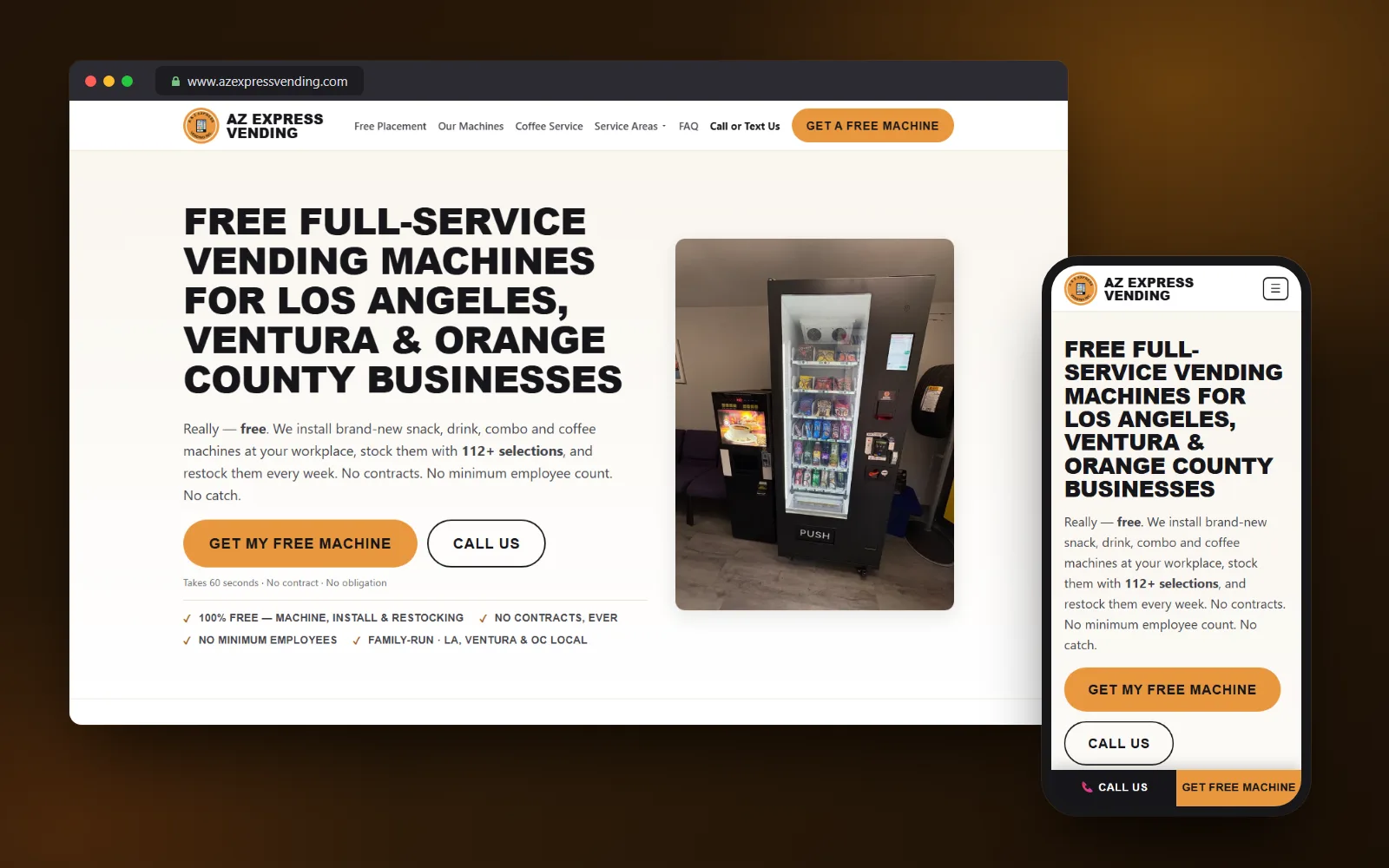
Prefer to watch? Here’s the AZ Express build as a short case-study video:
Gotham Refreshments — Staten Island, Brooklyn, Manhattan, and northern NJ. This client handed us a flyer, a logo, and six phone photos. Three days and 18 commits later they had a 25-page site: a brand system derived from the flyer, a 57-product catalog, hub-and-spoke city pages, deep structured data, and that six-step qualification quiz — live at gothamrefreshmentsllc.com. The build story, including how one black-field logo file became a complete brand system, is in the vending machine website design case study.
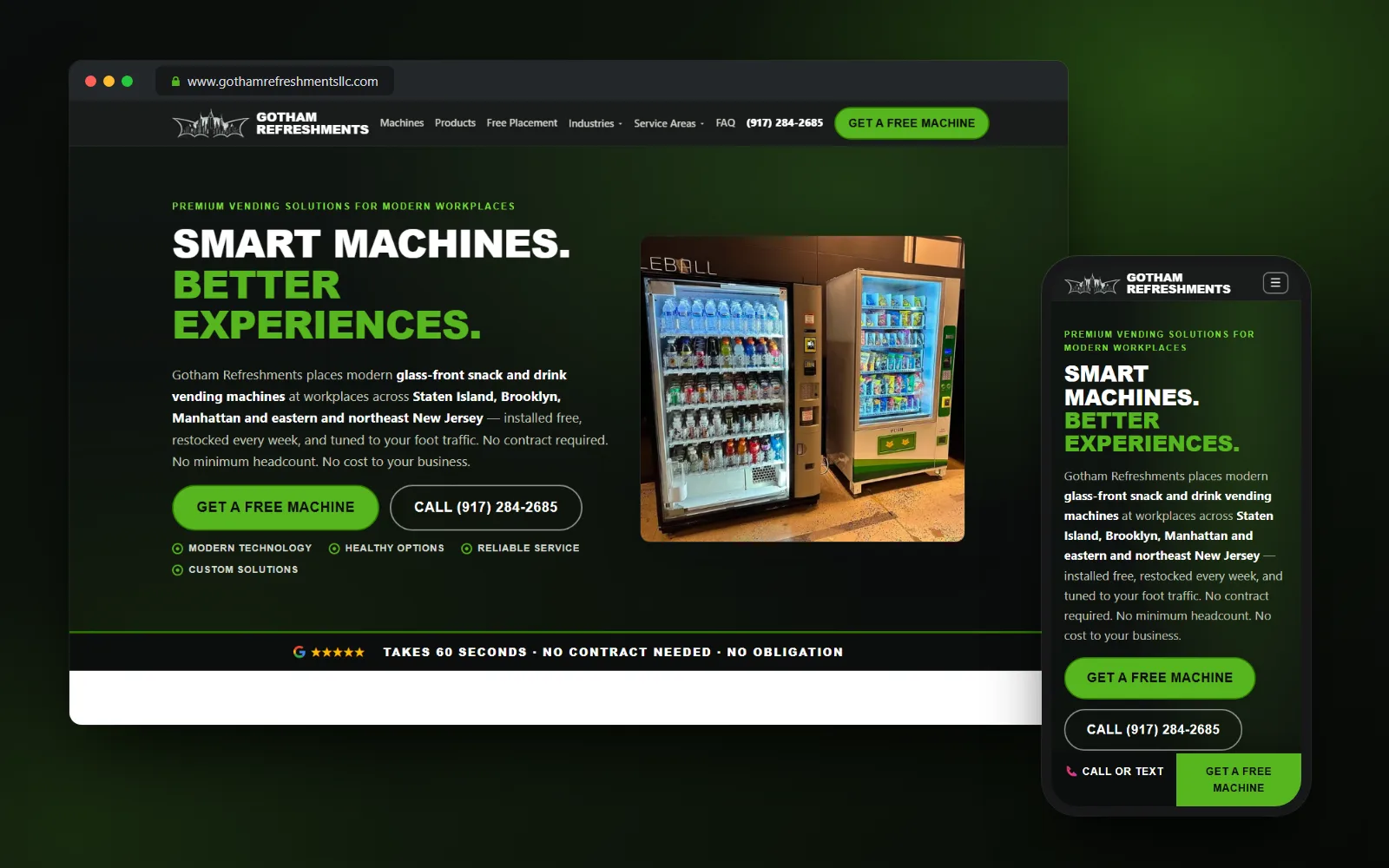
Two different operators, two different coasts, same architecture. That’s not a portfolio of mockups — it’s a repeatable blueprint with the commit history to prove the timelines.
When is a vending machine website template enough — and when isn’t it?
Honest answer: sometimes it’s enough. A vending machine website template on Squarespace or Wix is cheap, fast, and genuinely fine for a brand-new operator with three machines and one town — a clean template you actually launch beats a custom site you keep postponing. No strawmen here.
Templates fail at a specific, predictable point: when you need to rank, not just exist. A template gives you five pages; ranking along a route takes a page per service, per industry, per city — twenty-five to thirty pages on our builds — and stamping those out of a page builder by hand is where the “fast and cheap” math collapses. Templates also can’t give you the structured-data depth that local and AI search reward, and most carry enough script bloat that mobile speed scores land in the yellow no matter what you do.
The tell is your ambition. If the site’s job is making referrals feel safe calling you, use a template and spend the savings on machines. If the site’s job is producing location leads from search — the thing that actually fills routes — you’ll outgrow the template the day you try to compete for your second city.
Local SEO and AI search built into every page
Vending is a service-area business, which makes local SEO the engine and everything else the paint. Both of our operator builds run the same system: county or borough hubs, city pages with genuinely local copy, and local SEO plumbing — geo meta tags, breadcrumbs, one source of truth for name-address-phone so citations never drift.
The city pages deserve a word, because this is where most vending sites cheat and get discounted for it. Google has spent years devaluing “doorway” pages — forty copies of the same page with the town name swapped. We launch fewer, real pages instead: AZ Express opened with a small set of city pages, each naming actual streets, employers, and logistics quirks, and the site earns its way outward from there on demand data. Slower. Ranks.
The second layer is newer: AI search. When someone asks ChatGPT or Google’s AI results who places free vending machines nearby, the answer is assembled from structured data, quotable site content, and whether AI crawlers can read you at all. Both builds are wired for those systems from day one — machine-readable business facts, deliberate access for the crawlers that matter, and content written to be quoted. That’s AI search optimization as we practice it — an extension of technical SEO, not a separate mystery.
How much does a vending machine website cost?
Realistic 2026 brackets: $200–600 a year plus your own time on a DIY builder, $1,500–5,000 for a freelancer or template-based build, and $5,000–15,000 for a properly engineered custom site from an agency — most operators who hire it out land in the $2,000–12,000 professional range, plus $30–150 a month in hosting and tools. We wrote the full breakdown, hidden fees and all, in how much a small business website costs; the numbers here are the same ones, because they don’t change by industry.
What changes for vending is the page math. A one-town operator needs a modest site; a three-county route justifies the service-industry-city architecture above, and that’s more pages, more writing, more schema — the honest driver of where a quote lands in the range.
Two warnings worth their weight. The “free website” subscription deals common in route-service trades usually mean renting: cancel, and the site — sometimes the domain — disappears. And a $500 “custom” quote is a template with your logo dropped in. Whatever you pay, the deliverable must be an asset you own: domain in your name, admin access in your hands. Ask before signing.
Vending machine marketing beyond the website
Search for a vending machine marketing agency and you’ll find almost nobody who actually does this work — the results are a grab bag of machine sellers and decade-old articles. Which is odd, because the marketing problem is real: operators pay serious money for location leads, with Google Ads bid data putting vending-lead clicks in double-digit dollars, and the alternative to buying leads is building the machine that generates your own.
That machine has three parts beyond the website. A complete Google Business Profile with real machine photos and reviews from host locations, because the map pack takes the best real estate on a local search. Ongoing SEO services — content answering the questions operators’ prospects actually ask, technical health, the compounding work that turns a good site into a lead source. And, once tracking proves what a lead is worth, paid search through PPC management aimed at the handful of high-intent searches in your cities, sized to how many new locations your restocking capacity can absorb.
We’re not going to promise your route doubles — nobody honest guarantees outcomes in a niche this local. What we’ll promise is the engineering: a fast site, correct tracking, and a monthly number for leads and cost per lead you can check against your own inbox. Both vending builds above were designed, written, and shipped by the same team that would run your campaigns. That’s the whole pitch.